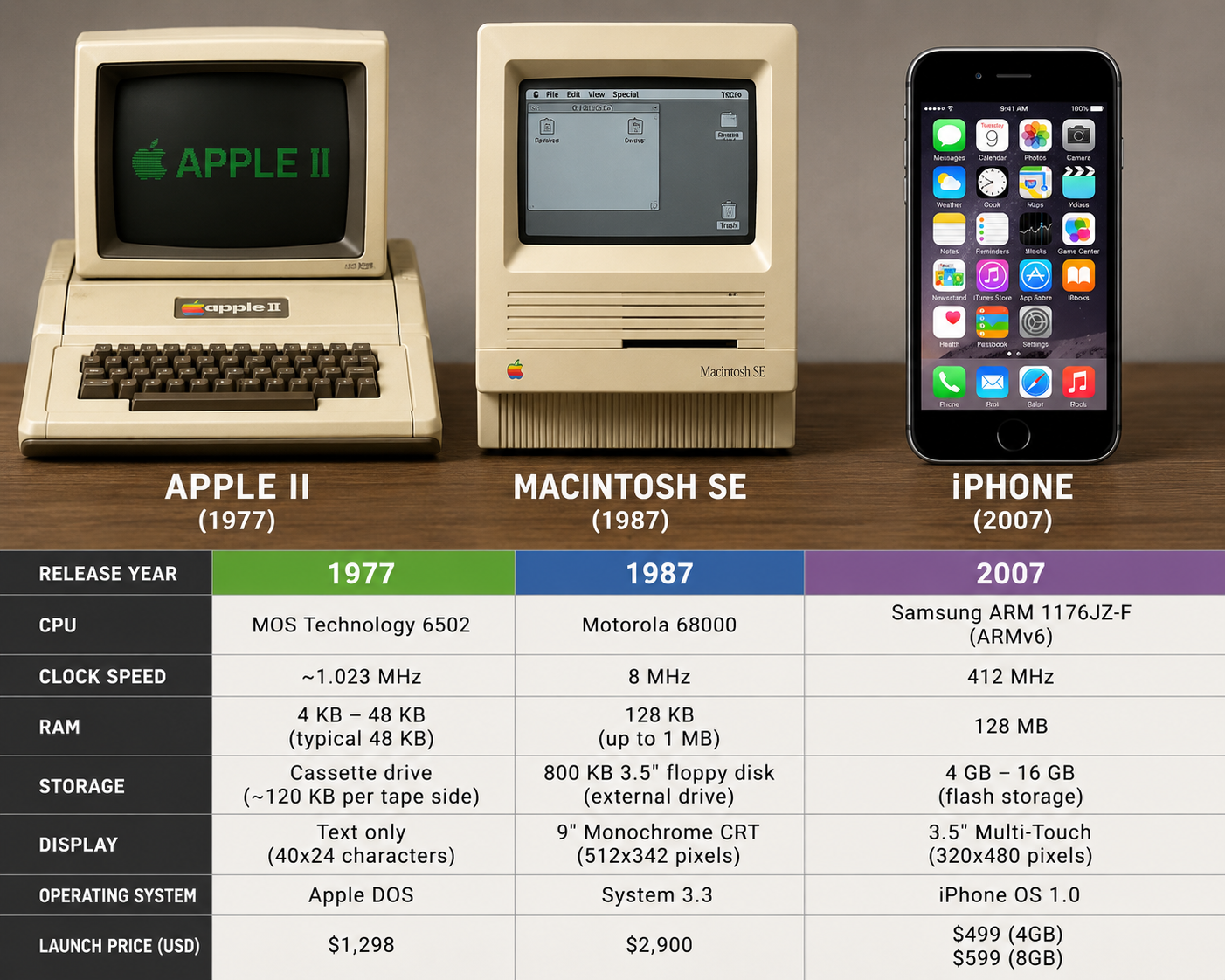
In 1977, the Apple II helped bring personal computing into homes and offices. Ten years later, the Macintosh SE represented a very different idea of what a personal computer could be. Another twenty years after that, Apple put a surprisingly powerful computer into people’s pockets with the original iPhone.
The numbers make the progression almost ridiculous.
Apple II — 1977
The Apple II used the MOS Technology 6502 processor running at roughly 1 MHz. Depending on configuration, memory was measured in kilobytes, not megabytes or gigabytes.
This was an era when simply having a computer sitting on your desk was exciting.
Macintosh SE — 1987
A decade later, the Macintosh SE used Motorola’s 68000 processor running at 8 MHz and brought Apple’s graphical Macintosh experience into a compact all-in-one machine.
The jump from the Apple II was substantial, but by modern standards its processing power and memory were still tiny.
iPhone — 2007
Then came the original iPhone.
Its processor ran at hundreds of megahertz, RAM was measured in megabytes, and storage was measured in gigabytes. It combined a computer, phone, camera, music player, web browser, and touchscreen interface into something small enough to carry everywhere.
Thirty Years
The most interesting comparison isn’t simply that computers became faster.
It’s that in only thirty years, computing went from something that occupied a substantial portion of a desk to something far more powerful that disappeared into a pocket.
And somehow we mostly use that incredible computing power to argue with strangers on the Internet.